
Understanding Your Bad Credit Score

Could your bad credit score be holding you back? This guide explains what a bad credit score means in Canada, how to check it, why they drop, and what you can do to improve your score. You’ll learn practical steps, see real cost examples, and get clear answers to common questions so you can confidently make a plan.
Aug 18, 2026
A low credit score often makes you feel defeated, over and over again. Loan applications get rejected, card limits shrink, interest costs rise, and it all seems to happen at the worst possible time. In fact, 20% of Canadians have poor credit and continually face this reality.
If you’re asking, “What is a bad credit score in Canada?” you’ve come to the right place. We’re here to provide you with clear answers and realistic steps to take charge of your finances and improve your score.
We’ll also cover how lenders read your credit file and why the same score can lead to different outcomes with different providers.
The goal is simple: to help you understand where you stand, what constitutes a bad score, and how to move in the right direction without guesswork.
Key Takeaways
A simple rule of thumb: a score below 600 is widely treated as bad credit in Canada, with most banks saying no and many alternative lenders charging higher rates.
You can check your score for free through Equifax and TransUnion. Pulling your own file is a soft inquiry, so it does not lower your score.
Bad credit can be improved. Small, consistent actions add up. On-time payments and lower balances matter more than quick tricks.
What Exactly Is a “Bad” Credit Score?
A credit score is a three-digit number that predicts how likely you are to pay your bills on time.
In Canada, scores generally range from 300 to 900. Lower numbers signal a higher risk to lenders. On the other end of the spectrum, higher numbers signal lower risk.
What exactly does a credit score measure?
A credit score is an estimate of the risk that you will miss a payment in the next 24 months. The score uses your payment history, balances, the length of your credit history, new credit inquiries, and the mix of credit types on your file.
What Credit Score Is Considered Bad in Canada?
Lenders use ranges to sort credit applications. While each lender sets its own cutoffs when deciding who it will lend to, they will tend to follow the same thresholds.
A common threshold is a score of 600. Scores below 600 tend to face steep hurdles at banks and credit unions. Scores in the low 600s may still face limits and higher rates with many providers.
Why 600? It sits at a point where the risk of missed payments rises across large groups of borrowers. Lenders respond by requiring stricter approvals, added documentation, higher security requests, or higher rates. This is why two people with similar incomes but different scores can see very different offers for the same credit product.
Let’s review common credit score ranges and how lenders view them.
Canadian Credit Score Ranges
Range (Approx.) | Label | What Lenders Often See | Typical Outcome |
800–900 | Excellent | Rare late payments, mature history | Best rates and limits |
740–799 | Very Good | Strong record with low balances | Very good rates and approvals |
670–739 | Good | Solid file, a few minor negatives at most | Broad approvals, fair pricing |
600–669 | Fair | Noticeable negatives or high balances | Conditional approvals, higher rates |
300–599 | Poor / Bad | Frequent late payments, collections, thin file, or recent serious issues | Many denials, steep pricing elsewhere |
Bad Credit Threshold
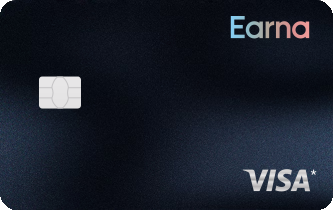
In Canada, anything below 600 is generally treated as bad credit. This is where many traditional lenders become hesitant or decline applications outright. If you’re under 600, you can expect extra conditions, requests for security, or a hard no from mainstream providers.[1] This kept many Canadians from owning a credit card until Earna launched its unsecured Visa* credit cards for those with poor or no credit.
How to Know if You Have Bad Credit
You can check your credit score and your full credit report to find out where you stand.
Until you do, a few signs can point to your score being in the low range:
You receive rejections for products you used to get approved for, even with a stable income.
Credit limits shrink without a change in your pay.
Interest rates offered are much higher than what you see advertised.
You get requests for security deposits on utilities or mobile plans.
Collection calls or letters arrive about past-due accounts.
These signs are only clues. Your actual report shows the items that shape your score. Once you see them, you can fix errors, plan payments, and monitor progress month after month.
Free Ways to Check Your Credit Score
There are two official sources for credit score checks in Canada.
Official Sources in Canada
Equifax.ca: Free report by mail or online.
TransUnion.ca: Free report by mail or online.
Important to know:
Checking your own credit is a soft inquiry. It doesn’t hurt your score, so you can technically check as often as you like. However, these reports are updated every month, so there is no need to request your report more frequently than that.
You can know more about the differences between Soft and Hard Inquiries by reading our dedicated article.
Checking Your Credit Score: Steps to Follow
Choose a free option above: Visit either Equifax.ca or TransUnion.ca. Both allow you to order a credit report by mail, and each now offers online access through a secure account. Creating both profiles gives you the broadest view of your credit health.
Provide basic info to verify your identity: You’ll be asked for your full name, address, date of birth, and Social Insurance Number (optional but helps ensure accuracy). The bureaus will use this information to locate your file and confirm you’re the rightful owner.
View your score immediately if you use an online account, or receive your report in 5–10 days if you choose mail: Online access gives you instant results and ongoing visibility into your file. Mail requests can take up to two weeks, depending on delivery times. When you receive your report, look carefully at the listed accounts, payment history, and public records to confirm they belong to you.
Check both Equifax and TransUnion: Each bureau collects data from different lenders, so one report may contain information the other does not. Comparing both helps you spot inconsistencies, missing accounts, or errors that could unfairly lower your score. Did you find discrepancies? You can contact the bureau directly to dispute them and request corrections.
What Causes Bad Credit?
A bad score comes from signals that suggest a higher risk to lenders. The causes of these signals are fixable once you know what they are. Some take time, others change in a single update.
Reasons Why Your Credit Score is Low
There are all kinds of reasons your credit score could be low, and a lot of them don’t have anything to do with missing payments, having a high balance, or similar issues.
Below, you’ll find eight of the most common reasons credit scores are low, ranging from late payments to errors on your credit report:
Late or missed payments: Even a single late payment can hurt, and recent late payments weigh more.
High balances vs limits: Using a large share of your available credit (utilization) can pull your credit scores down.
Collections or charge-offs: Unpaid debts that reach collections have a strong negative effect.
Recent hard inquiries: Multiple new credit checks in a short span suggest strain and can lower your score.
Short credit history: A thin or new file contains less positive data, leading lenders to perceive more uncertainty.
Accounts at or over limit: Signals cash flow issues and raises risk flags for providers.
Public records: Consumer proposals or bankruptcies weigh heavily while they remain on file.
Errors on the report: Wrong late payments, duplicate accounts, or mixed files can drag a score down without any real mistake on your part.
What matters most over time is payment history and how much of your credit you use. If you pay on time and keep balances well below your limits, scores tend to climb. Length of history, types of credit, and new inquiries matter too, but they carry less weight than on-time payment habits and lower balances.
If your report has errors, you can dispute them with the bureau that shows the mistake. Provide documents that support your case. When the bureau confirms an error, it updates your report. That update can give your score a nice lift and help future credit applications.
Now, a final note on sustainable credit score improvements.
Real improvement comes from a few steady actions over months. Small wins add up. On-time payments and lower utilization will gradually improve your score over time.
How Bad Credit Affects You
A bad credit score might affect the price you pay for money (borrowing) and the products you can get.
Main Areas of Impact:
Below are the areas where a bad score has the most visible effect.
Loans and Credit Products:
Traditional banks: Often decline applications below 600.
Alternative lenders: May approve, but at higher rates (for example, 15–47% versus 5–12% with strong credit).
Credit cards: Offers tend to be secured cards that require a $300–$500 deposit.
Mortgages: Very difficult below 600, and may require a 20%+ down payment if approved through specialized lenders.
Real Cost Example
If you have a $10,000 personal loan with an 8% interest rate, this means you’ll pay about $66 per month in interest and principal blended over the term, depending on the amortization.
That same $10,000 loan at 25% jumps to about $300 per month. That is $1,700 more per year in interest alone. Over a multi-year term, the difference compounds.
Utilities and Cell Phones
With a bad score, you may face a security deposit for electricity, gas, or mobile plans. Some providers ask for pre-authorized payments or smaller device financing limits.
Insurance
Insurers may review elements of your credit profile to help price risk. Poor credit can lead to higher premiums where this practice is permitted.
Employment
Some employers, mainly in roles that involve cash handling or sensitive financial duties, may request a credit check during hiring. They use it to assess financial reliability.
Emotional and Mental Health
Money stress is real. Higher costs and rejections add pressure, but a plan helps. Once you identify the items holding you back, each on-time payment becomes a measurable step forward.
Earna believes everyone deserves a second chance at financial freedom.
Our Visa* cards are designed for those with poor or no credit, and nearly everyone is approved. Check out the two Earna Visa options to see which one is best for you.
Can Bad Credit Be Fixed?
Yes! Rest assured, you can improve your credit just like thousands of Canadians have before you. Improving your score takes time and steady action. The timeline depends on what primarily lowered your score. For example, recent late payments can fade in weight after several months of on-time payments.
Collections take longer to improve, and a bankruptcy or proposal requires even more time. That said, the score can still improve during and after these events if there is an ongoing, clean record of responsible use.
Ready to take an action? Start with two steps:
Pay on time from this month forward and lower your credit utilization. Aim to keep each credit product below 30% of its limit, and lower if possible.
Set up automatic payments for at least the minimums to prevent accidental late payments.
There is no instant shortcut, but consistency wins. If you stick with a simple plan, most files see visible progress within six to twelve months, and stronger gains after that.
For comprehensive strategies on rebuilding your credit, see Earna’s bad credit solutions.
Conclusion: Do I Have Bad Credit?
Bad credit doesn’t have to be forever. You can raise your score with simple steps you repeat month after month. Pay on time, keep balances low, build positive history, and correct errors. Small moves stack up and open the door to better rates and better products.
If you’re ready to take action, Earna can help you with tools that support checking your status and choosing a path forward. Start your application now and see your options in minutes.
[INSERT CTA] Start Your Application – It Only Takes Minutes
Sources:
https://www.equifax.ca/personal/education/credit-score/articles/-/learn/what-is-a-good-credit-score/
https://www.equifax.ca/personal/products/equifax-consumer-credit-report
https://www.transunion.ca/product/consumer-disclosure#articleSection3
https://www.transunion.ca/product/consumer-disclosure#articleSection2
About the authors

Dominic Abate
Dominic has worked in financial planning, banking and auto finance, and writes about all aspects of money. His work has appeared in Time, Success, USA Today, Credit Karma, NerdWallet, Wirecutter and more.
Can't find what you're looking for?
Contact us here:
[email protected]
Quick answers to questions you may have
Is 600 a bad credit score?
How do I check if I have bad credit?
How long does bad credit last?
Does checking my credit score lower it?
What’s the fastest way to improve bad credit?
Can bad credit affect my job prospects?
Related Articles

Bad Credit Credit Cards With Cash Advance Options
When an unexpected expense hits—a car repair, medication, or rent shortfall—many Canadians with bad or no credit feel they have nowhere to turn. Traditional loans may be unavailable, and quick-cash options often come with steep costs and confusing terms. If you’re asking, “Can I get a cash advance with bad credit?” you’re not alone. The reality is that some credit card cash advance Canada options exist even for people with poor credit. But access doesn’t always mean affordability—or safety. This guide explains how a cash advance with a credit card works, which types of cards may allow it, the fees and risks to expect, and when alternatives make more sense. The goal is to help you make informed decisions that protect your financial recovery—not undermine it.